

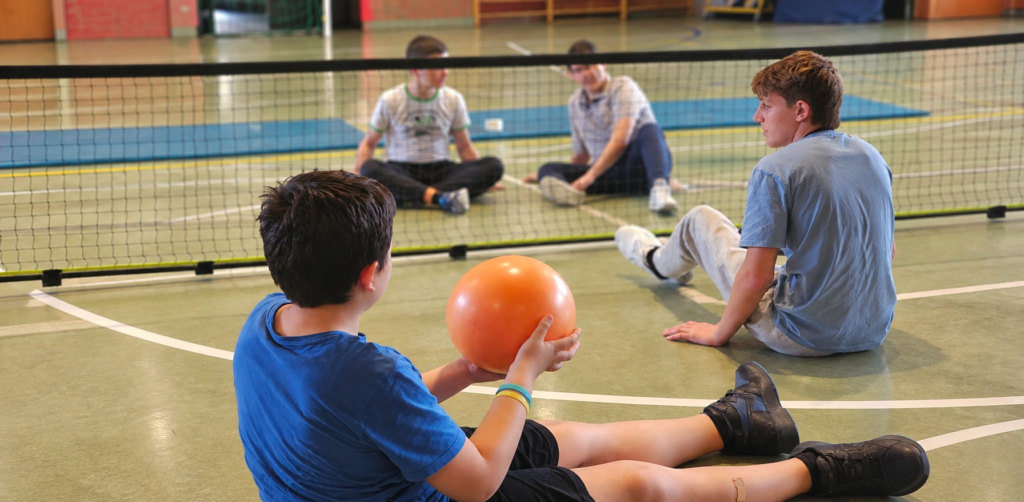
At the IRCCS Eugenio Medea in Bosisio Parini (Italy), sport and rehabilitation come together within the SWAP project, exploring and testing approaches to make sitting volleyball increasingly accessible to children and young people with complex neuromotor disabilities.
The initiative was launched in the IRCCS gym through a collaboration with Real Eyes Sport, initially offering a sitting volleyball programme for the Institute’s outpatients. The sessions, jointly led by rehabilitation professionals and sports coaches, provided participants with the opportunity to engage in a group-based activity while allowing professionals to observe, in a real-life setting, how individuals with different motor abilities could approach and participate in the sport.
Following the positive experience of this initial programme, a further step was taken: sitting volleyball was introduced on an experimental basis for children and young people undergoing inpatient rehabilitation at the IRCCS, with a weekly group sports session incorporated into their rehabilitation schedule.
In this way, sport becomes directly integrated into the rehabilitation pathway. Alongside individual rehabilitation sessions, participants have the opportunity to engage in a different, dynamic and motivating environment, where movement, play, peer interaction and cooperation become part of the rehabilitation experience.
The programme has involved young people with different neuromotor conditions, including cerebral palsy and acquired brain injury following traumatic brain injury. This experience has enabled the team to begin identifying adaptations that may make sitting volleyball accessible when motor impairments make it difficult to perform conventional technical skills or comply with the standard rules of the game.
For example, a young person with difficulties in fine motor control, coordination or upper-limb motor control may find it challenging to immediately return the ball using the techniques normally required in volleyball. Allowing the player to briefly stop and catch the ball before returning it may represent a useful adaptation, enabling active participation in the rally and facilitating an understanding of the dynamics of the game.
Similarly, the floor-seated position that characterises sitting volleyball is not accessible to everyone. When trunk control is insufficient, the activity can be performed while the participant remains seated in a wheelchair, with the involvement, when necessary, of a peer without motor disabilities who can assist with wheelchair positioning during play.
These modifications may appear simple, but they represent a fundamental shift in perspective: rather than necessarily asking the individual to adapt to the sport as it has traditionally been codified, the aim is to identify which elements of the game can be modified without losing its essential meaning, so that every participant can be actively and meaningfully involved.
This is one of the key features of the experience developed at the Medea within the SWAP project. The gym becomes a true laboratory where clinical, rehabilitation and sports expertise come together.
Physiatrists, physiotherapists, developmental neuro and psychomotor therapists, and other rehabilitation professionals contribute their knowledge of motor functioning and of each participant’s individual needs. Real Eyes Sport coaches, in turn, bring their expertise in sports practice, game design and group management.
During the sessions, professionals observe not only the difficulties encountered by participants, but also the strategies they spontaneously develop and the solutions that allow them to become more actively involved in the game. These observations progressively inform adaptations to technical skills, rules, postures and methods of delivering the activity.
The process is therefore necessarily dynamic: adaptations are proposed, tested in practice and progressively refined according to the participants’ responses.
The experience gained during the first months of the programme is also highlighting the value of providing patients, within their rehabilitation schedule, with an environment in which their abilities can be used towards a goal that differs from that of a conventional therapeutic session.
Team play requires participants to reach the ball, control it, direct it towards a teammate, decide how to respond, follow turns and rules, communicate and cooperate. Motor actions therefore immediately acquire a concrete, functional and relational purpose.
For rehabilitation professionals, this context also provides an opportunity to observe the young person in a setting that differs from individual therapy. Motor strategies, adaptive abilities, interaction patterns and levels of participation may emerge, providing additional information that can contribute to a more comprehensive understanding of the individual’s functioning.
The collaboration between IRCCS Eugenio Medea and Real Eyes Sport within the SWAP project is therefore based on a shared perspective: to make sport accessible to children and young people with complex neuromotor disabilities while simultaneously exploring, in practice, which adaptations can enable each individual to participate actively and meaningfully.
The ultimate goal is to translate the knowledge gained through these experiences into transferable tools and practical approaches, so that sitting volleyball can become an increasingly inclusive and replicable activity, including beyond the rehabilitation setting.