

Sport can be much more than just physical activity: it can become a powerful tool for rehabilitation, personal growth and inclusion. This conviction lies at the heart of one of the most innovative aspects of the SWAP project, which aims to make sitting volleyball increasingly accessible to children and young people with neuromotor disabilities through close integration between sports, rehabilitation and scientific expertise.
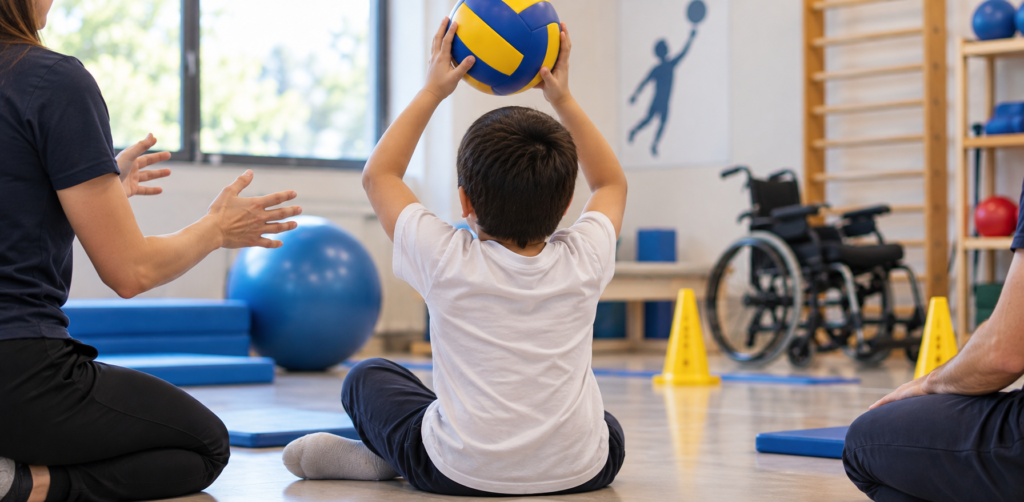
The activities already underway at the IRCCS Eugenio Medea in Bosisio Parini provide a concrete example of this approach. Here, children and young people take part in training sessions that are not simply opportunities to practice sport, but genuine applied research laboratories, in which every activity contributes to a deeper understanding of participants’ needs and to the development of increasingly effective solutions to support their participation in sitting volleyball.
Putting these principles into practice starts with the daily work of a multidisciplinary team. Specialised coaches from Real Eyes Sport, rehabilitation physicians, physiotherapists, developmental neuro- and psychomotor therapists, and researchers share their expertise, observations and “on-the-field” experiences with the common goal of creating truly accessible sports pathways that can enhance the potential of every child.
In this context, sport is not simply the final stage of the rehabilitation process, but an integral and fundamental part of it. The clinical expertise of the professionals at the Medea Institute makes it possible to understand the functional characteristics of each participant, identifying their strengths, needs and possible intervention strategies. At the same time, the experience of Real Eyes Sport coaches enables these indications to be translated into engaging sporting activities, in which technical skills and movements are progressively adapted to the abilities of each individual participant.
The collaboration between healthcare and sports professionals is continuous and, above all, two-way. During every training session, movement patterns, strategies, challenges and the spontaneous solutions adopted by each child are observed. These observations are then shared and analysed, becoming the basis for modifying exercises, adapting game rules, rethinking the tools used and developing new methodological approaches.
At the same time, sports practice provides rehabilitation professionals with a rich and dynamic context in which to observe abilities that may be difficult to identify during traditional therapy sessions. Playing, interacting with teammates, making quick decisions and adapting to competitive situations make it possible to identify motor, cognitive, relational and emotional aspects that are essential to understanding the person’s overall functioning.
This continuous exchange allows scientific research and sports practice to mutually reinforce one another. The result is a process of continuous improvement, in which every training session becomes an opportunity to refine the technical, methodological and regulatory adaptations needed to make sitting volleyball increasingly inclusive.
The ultimate goal is not only to enable a greater number of children and young people with neuromotor disabilities to practice this sport, but also to build a stable model of collaboration between the healthcare and sports sectors. A model in which different professionals work together, each contributing their own expertise to generate a broader impact on the wellbeing, autonomy, social participation and quality of life of young athletes.
The first activities are already confirming the value of this interdisciplinary approach. When sport and rehabilitation engage in constant dialogue, sport becomes much more than a recreational activity: it becomes a space for learning, social interaction and personal growth, capable of fostering the development of motor skills, self-confidence and active participation in community life.