

What if the only thing standing between a child and the joy of team sport was simply the way the game is designed?
Sport has the power to bring people together, improve health and create a sense of belonging. Yet for many children and young people with disabilities, taking part in regular sports activities is still far from easy. Physical barriers, limited access to adapted programmes, lack of awareness and persistent stereotypes continue to prevent many young people from enjoying the physical, social and emotional benefits that sport can offer. As a result, they often miss valuable opportunities to build friendships, develop confidence and become active members of their communities.
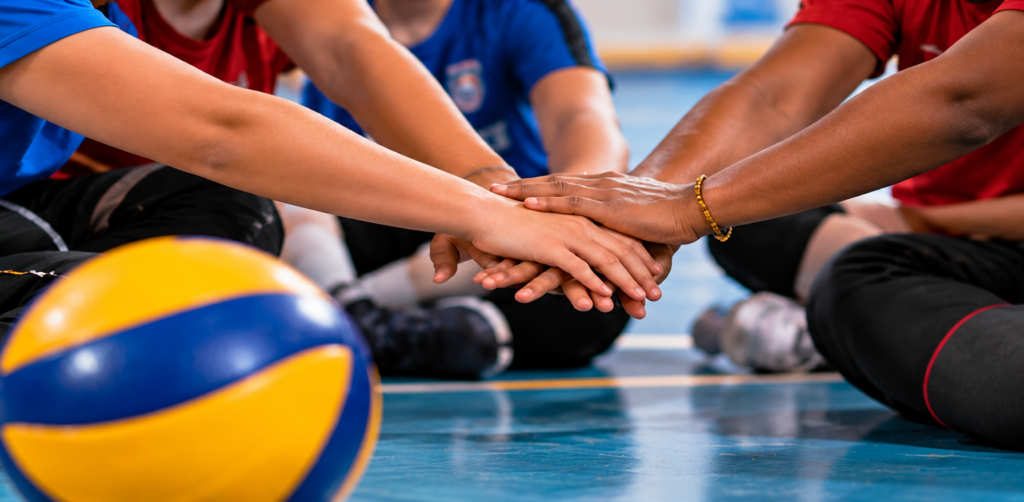
Sitting volleyball offers a different perspective. Originally developed to make volleyball accessible to people with physical impairments, it has grown into one of the most successful examples of inclusive sport. By adapting a few elements of the game, including playing while seated, using a lower net and a smaller court, sitting volleyball creates an environment where people with and without disabilities can play together, compete together and enjoy the same sporting experience.
Sitting volleyball stands out because it allows athletes with different types and levels of physical impairment, and even people without disabilities, to play the same game together with only minimal adaptations. Everyone competes under the same rules while remaining in constant contact with the floor, reducing the influence of standing height or lower limb function on performance. Success depends on anticipation, ball control, tactical awareness and teamwork rather than on jumping ability or speed alone. This creates a sport where players with diverse abilities can contribute meaningfully to the same team and where inclusion becomes part of the game itself rather than an additional objective.
The impact of this kind of participation extends well beyond physical fitness. Regular involvement in sport can improve strength, coordination and functional movement, but it also supports emotional wellbeing and personal development. Children who participate in team sports often develop greater self-confidence, learn to communicate effectively, solve problems together and experience the satisfaction of achieving shared goals. For children with disabilities, these experiences can play an important role in building independence and resilience while reinforcing a positive sense of identity.
Inclusive sports also help challenge attitudes towards disability. When children grow up playing together, disability becomes only one characteristic among many rather than something that defines a person’s abilities. Teammates learn to appreciate each other’s strengths, support one another and work towards common objectives. These shared experiences encourage respect, empathy and social inclusion in ways that cannot always be achieved through awareness campaigns alone.
The benefits are not limited to the children who participate. Families gain confidence when they see their children enjoying sport in a welcoming environment. Teachers and coaches discover practical ways to make physical activity accessible to all students. Healthcare professionals increasingly recognise that participation in sport can complement rehabilitation by supporting long-term physical activity, social participation and overall quality of life. When schools, sports clubs, rehabilitation services and families work together, they create stronger pathways for children to remain active throughout their lives.
Ultimately, sitting volleyball demonstrates that inclusion does not require extraordinary solutions. Sometimes, small adaptations are enough to create opportunities that benefit everyone. When every child has the chance to participate, compete and belong, sport becomes much more than physical activity. It becomes a powerful tool for health, friendship, confidence and equal opportunities.
Sources
International Paralympic Committee (IPC). (n.d.). Sitting Volleyball. https://www.paralympic.org/sitting-volleyball
World ParaVolley. (n.d.). Sitting Volleyball. https://www.worldparavolley.org/sitting-volleyball/
United Nations. (2006). Convention on the Rights of Persons with Disabilities (CRPD). https://www.un.org/disabilities/documents/convention/convention_accessible_pdf.pdf
World Health Organization. (2010). Community-Based Rehabilitation: CBR Guidelines. Geneva: WHO. https://www.who.int/publications/i/item/9789241548052
National Center on Health, Physical Activity and Disability (NCHPAD). (n.d.). Inclusive Physical Activity and Sport Resources. https://www.nchpad.org
Vute, R. (2008). Teaching and Coaching Volleyball for the Disabled: Foundations and Methods. International Volleyball Federation (FIVB).
Shields, N., & Synnot, A. J. (2016). Perceived barriers and facilitators to participation in physical activity for children with disability: A systematic review. British Journal of Sports Medicine, 50(23), 1474–1484. https://doi.org/10.1136/bjsports-2015-094890