

How small adaptations create big opportunities
What if the biggest barrier keeping a child from enjoying sport is not their motor disability, but the way a training session is designed? This is where a coach can make a decisive difference. A good inclusive coach asks not only how to teach a skill or win a match, but how to help every child participate, improve and feel that they belong to the team.
Sport matters for physical and emotional health, yet opportunities to participate are not equally available to everyone. Children and young people with disabilities may face inaccessible facilities, a shortage of adapted programmes and mistaken assumptions about what they can do. The right to participate in sport is recognised by the UN Convention on the Rights of Persons with Disabilities, while the World Health Organization highlights the health value of appropriate physical activity. However, between an open sports hall door and genuine inclusion lies the everyday work of the coach.
Get to know the person before adapting the session
Two children with the same diagnosis may have different abilities, interests and goals. Coaches therefore need to talk with young athletes, listen to what works for them, recognise their strengths and agree on achievable challenges. One child may need more time to react, another a shorter drill or a different explanation. Adaptation does not mean lowering expectations: it means finding ways for everyone to learn and progress. Research into relationships between coaches and athletes with disabilities particularly highlights knowledge, communication, trust and a willingness to keep learning.
A simple tool is the STEP model: adapt the Space, Task, Equipment or People and their roles. In practice, this might mean a smaller court, a lighter ball, extra time to complete an activity or differently matched pairs. The important thing is to observe how an adaptation works and adjust it together with the athletes, rather than deciding in advance what someone “cannot do”.
Being present is not the same as taking part
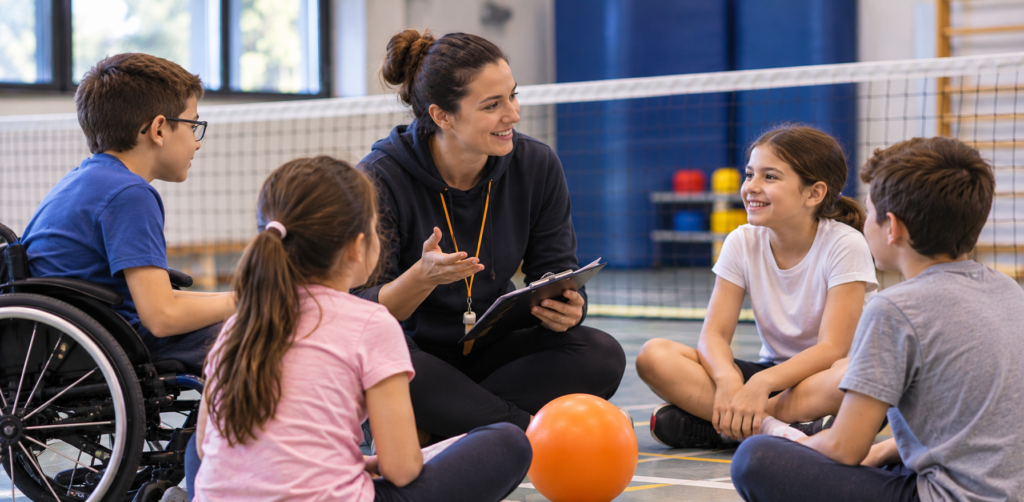
Imagine a child spending the whole session standing or sitting on the sidelines while everyone else plays. That child has attended training but has not really been included. Coaches should therefore notice who receives the ball, who makes decisions and who is always waiting. Rotating roles, encouraging cooperation and setting tasks to which everyone can contribute help create a sense of belonging. The principle of meaningful involvement promoted by Special Olympics reminds us that each teammate should have a chance to contribute to shared success, with safety and respect.
What can sitting volleyball teach us?
In the SWAP project, sitting volleyball provides an excellent example of a sport that can be adapted to different abilities. Coaches can progressively develop seated movement, passing, teamwork and understanding of the game. In introductory or school sessions, they may adjust the size of the playing area, the pace of the game or a particular task so that more children can take an active part. These educational adaptations should, however, be distinguished from official competitions, which follow World ParaVolley rules.
Coaches are not alone in this process. Working with parents, PE teachers, physiotherapists and other professionals can help them plan safe and suitable activities while respecting the child’s privacy and own voice. The club also has responsibilities: providing accessible spaces, equipment and opportunities for professional development. Inclusion cannot depend solely on one person’s goodwill.
Ultimately, the most important question after a session is not only “Did we play well?” but also “Did everyone have a chance to play, and do they want to come back?”. When coaches combine knowledge with empathy, clear goals and a willingness to adapt, sport becomes a place where differences do not divide a team, they enrich it.
References
United Nations. Convention on the Rights of Persons with Disabilities (CRPD) – Article 30: Participation in cultural life, recreation, leisure and sport. https://www.un.org/development/desa/disabilities/convention-on-the-rights-of-persons-with-disabilities/article-30-participation-in-cultural-life-recreation-leisure-and-sport.html
World Health Organization. (2020). “WHO guidelines on physical activity and sedentary behaviour: at a glance”. https://www.who.int/publications/i/item/9789240014886
UK Coaching. “The STEP Model”. https://www.ukcoaching.org/ukc-club/resources/the-step-model/
Special Olympics. Principle of Meaningful Involvement. https://media.specialolympics.org/resources/sports-essentials/unified-sports/Unified-Sports-Principles-of-Meaningful-Involvement.pdf
Liu J., et al. (2024). “Factors influencing the relationship between coaches and athletes with disabilities: a systematic review”. National Library of Medicine. https://pmc.ncbi.nlm.nih.gov/articles/PMC11439722/
World ParaVolley. Sitting Volleyball Rules and Regulations. https://worldparavolley.org/sitting-volleyball-rules-and-regulations/