


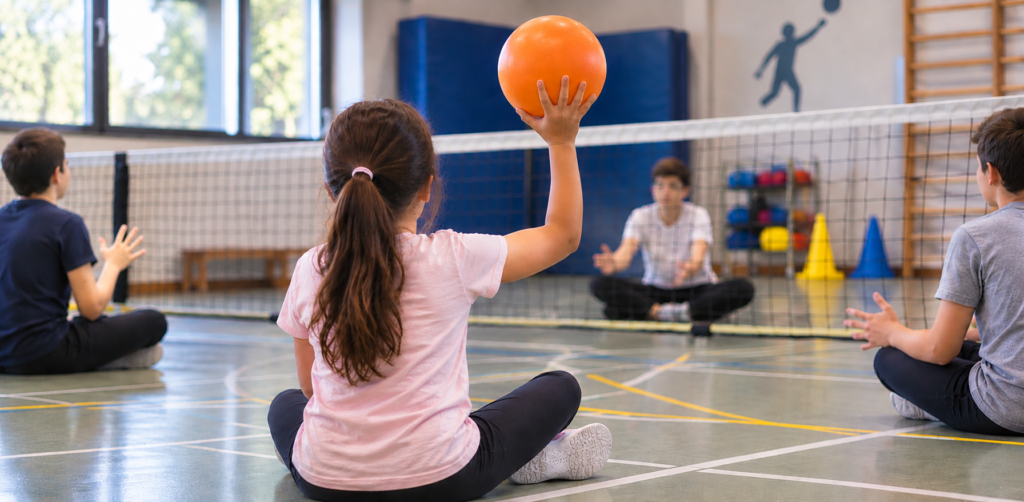
Starting a new sport can be an exciting experience, but it can also be challenging for children who have never played in a team before. For children with physical and motor disabilities, finding an activity that matches their abilities, interests and needs is particularly important. Sitting volleyball offers an engaging introduction to team sport, allowing children to discover the game, develop new skills and gradually become comfortable playing with others.
One of the main advantages of sitting volleyball is that its basic objective is easy to understand. Two teams face each other across a net, trying to send the ball into the opponent’s court while preventing it from touching their own side. The smaller court and lower net distinguish sitting volleyball from conventional volleyball, while players remain in contact with the floor during play. These characteristics provide opportunities to introduce the game through activities adapted to different levels of experience and ability.
Children do not need to master every technical skill before they can begin. Their first sessions can focus on simple activities such as rolling, throwing, catching or directing a ball towards a target. Once they become familiar with controlling the ball, they can practise passing in pairs, keeping the ball in the air and cooperating with teammates. These activities gradually introduce the basic skills of volleyball while allowing children to experience the game from the beginning.
This progressive approach is particularly important for beginners. When activities are too difficult or instructions are overly complicated, children may become frustrated before they have had the opportunity to enjoy the sport. Sitting volleyball allows coaches to simplify exercises, adjust the distance between players and modify the pace of activities according to individual needs. Equipment can also be adapted where appropriate, for example by using a lighter ball or a larger target. The aim is to provide a manageable challenge that encourages learning without removing the excitement of playing.
Another important advantage is that sitting volleyball introduces children to the essential principles of team play. Success depends not only on individual skills but also on communication, anticipation and cooperation. Even simple exercises can encourage players to decide who will receive the ball, where to direct it and how to help their teammates. As their abilities develop, children can progress from cooperative activities to small-sided matches in which they begin to understand positioning, tactics and the importance of working towards a common objective.
For children with physical and motor disabilities, the opportunity to contribute meaningfully to a team is particularly important. Coaches should recognise that participants may have different functional abilities, coordination levels and learning speeds. Rather than expecting everyone to perform the same movements in exactly the same way, activities can be adjusted to allow each child to participate as actively as possible. Clear instructions, demonstrations and individual feedback can also make learning easier. These adaptations should preserve the fundamental challenge of the game while ensuring that every participant has opportunities to practise and improve.
The way a first session is organised can influence whether a child wants to return. A welcoming atmosphere, achievable tasks and encouragement from coaches and teammates help children feel comfortable trying something new. Mistakes should be treated as a normal part of learning, and progress should be recognised without constant comparisons between players. Families can also support this process by encouraging participation and allowing children to discover which aspects of the sport they enjoy most.
Making sitting volleyball accessible requires attention to more than the game itself. Suitable facilities, appropriate equipment, trained coaches and good communication with families can all influence whether children have the opportunity to participate regularly. Research on physical activity among children with disabilities has identified environmental, practical and social barriers that can limit participation. Addressing these factors is therefore essential when introducing a new sporting activity and creating opportunities for continued involvement.
Within the SWAP project, promoting sitting volleyball means helping sports organisations, educators and other professionals understand how to make that first experience possible. By introducing the game progressively and adapting activities to individual needs, coaches can help children discover the enjoyment of team sport while developing their skills and confidence as players. Sitting volleyball can therefore serve as a valuable starting point for a sporting journey in which children have the opportunity to learn, participate and find a team where they feel welcome.
References
World ParaVolley. Sitting Volleyball Rules and Regulations. https://worldparavolley.org/sitting-volleyball-rules-and-regulations/
Shields N, Synnot AJ, Barr M. Perceived barriers and facilitators to physical activity for children with disability: a systematic review. British Journal of Sports Medicine. 2012;46(14):989–997. https://doi.org/10.1136/bjsports-2011-090236
Martin JJ. Benefits and barriers to physical activity for individuals with disabilities: a social-relational model of disability perspective. Disability and Rehabilitation. 2013;35(24):2030–2037. https://doi.org/10.3109/09638288.2013.802377